
26 June 2025 — By combining Life Cycle Assessment (LCA) with GeoPolRisk methodology, BRGM study offers a holistic view of trade-offs between environmental impacts and supply risks.
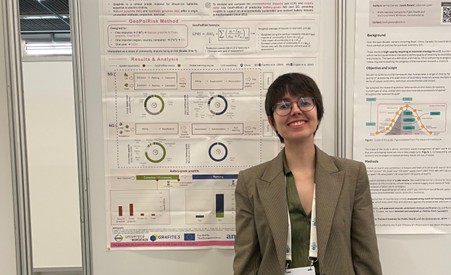
As a key partner in the GR4FITE3 project, BRGM actively contributed to the SETAC Europe 35th Annual Meeting, held in Vienna from 11–15 May 2025. During the event, Aina Mas Fons presented a poster titled “Understanding the Production of Natural and Synthetic Battery-Grade Graphite: European Union Perspective on Supply Risk and Environmental Impact Implications.”
The study compared natural graphite (NG) and synthetic graphite (SG) in the context of their growing importance for lithium-ion battery production in the EU. Findings revealed that NG production results in a lower climate change impact (5.4 kg CO₂eq/kg) than SG (10.3 kg CO₂eq/kg), supporting EU sustainability targets. However, NG is largely sourced from China, posing a higher supply risk. Conversely, SG offers more secure supply but at greater environmental cost due to energy-intensive processes.
By combining Life Cycle Assessment (LCA) with GeoPolRisk methodology, the study offers a holistic view of trade-offs between environmental impacts and supply risks. Both NG and SG are expected to remain essential in the EU’s efforts toward a resilient and sustainable battery value chain.
Read the abstract here.
Ph: Aina Mas Fons (BRGM) presentation for the SETAC 2025 conference in Vienna
