13 June 2026 — Researchers from the Kyiv National University of Technologies and Design have developed an innovative processing strategy that could make the production of battery-grade graphite more efficient, reducing material losses while delivering the high purity and performance required for next-generation lithium-ion batteries.
Natural graphite is an attractive raw material for battery anodes, thanks to its excellent electrochemical properties, long cycle life and relatively low cost. However, before it can be used in batteries, it must undergo two critical processing steps.
The first is purification. Battery manufacturers require graphite with a carbon content above 99.95%, as even small amounts of mineral impurities can affect battery performance, lifetime and safety.
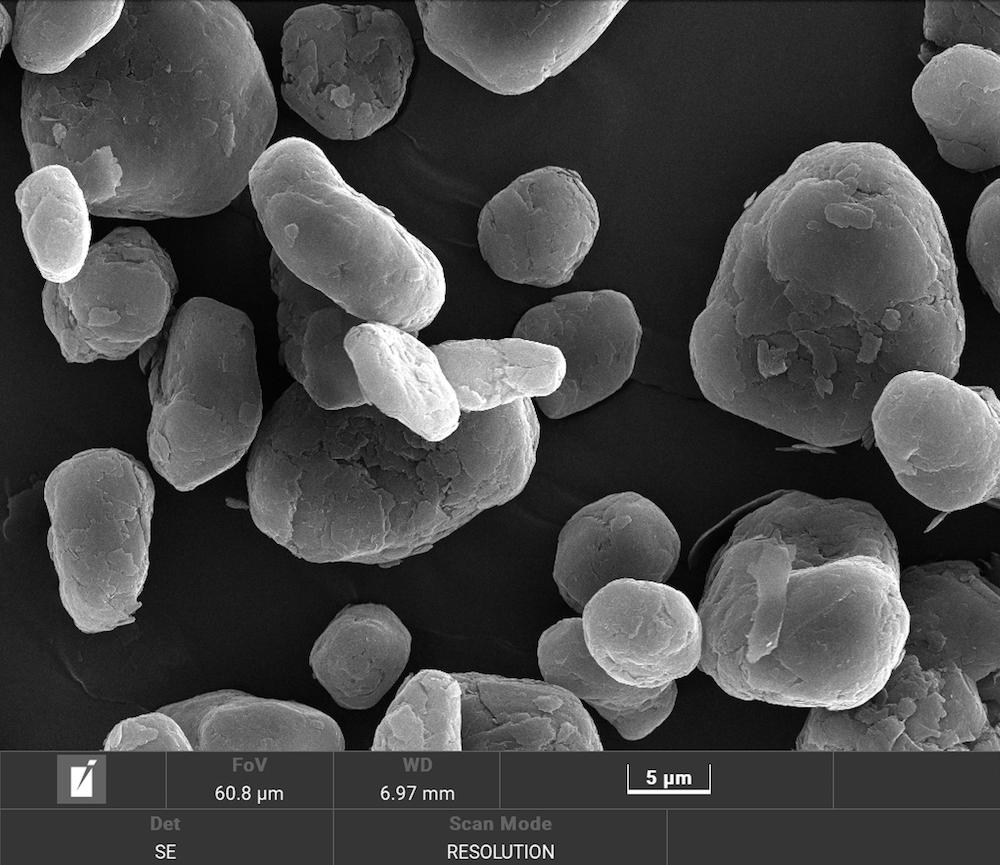
The second is spheroidization, a mechanical process that transforms naturally flaky graphite particles into nearly spherical ones. This rounded shape allows particles to pack more efficiently inside the battery electrode, increasing energy density and improving overall battery performance.
Both steps are essential, but they also present a manufacturing challenge. Conventional production routes typically purify graphite to battery-grade quality before spheroidization. The problem is that spheroidization is inherently inefficient: only around half of the processed material becomes usable spherical graphite, while the remainder ends up as fine particles unsuitable for battery anodes, leading to a significant fraction of already purified, high-value graphite being lost during processing.
Rethinking the production sequence
The research team at KNUDT explored an alternative approach that changes the order of the final manufacturing steps: instead of producing ultra-pure graphite first, they begin with partially purified natural graphite, convert it into spherical particles, and only then carry out the final purification step.
This simple change has an important advantage: only the graphite that will ultimately be used as battery material undergoes the most demanding purification treatment, reducing unnecessary processing of material that would otherwise be lost.
Sustainable Graphite Purification with Minimal Fluoride Use
An equally important aspect of the work is the purification process itself. Rather than relying on conventional hydrofluoric acid-based treatments, the researchers developed a method using dilute sulphuric acid together with a small amount of ammonium fluoride.
In this process, ammonium fluoride helps breaking down silicate impurities so they can be removed more efficiently by the acid. Because only a limited amount of fluoride is required, the process significantly reduces the use of fluorinated chemicals while maintaining high purification efficiency.
Developing such lower-impact processing routes is fully aligned with the objectives of GR4FITE3, which aims to strengthen Europe’s battery materials value chain through more sustainable technologies.
High purity without compromising material quality
The researchers tested the new approach using natural graphite from the Ukrainian Zavallivske Graphite deposit. Following spheroidization and chemical post-purification, the resulting graphite achieved carbon over 99.95%, fully meeting the requirements for lithium-ion battery anodes.
Equally encouraging, microscopic analysis showed that the spherical particles retained their structure throughout the proposed acid purification process; this is essential, as particle shape plays a major role in determining electrode density and battery performance. It should be noted that graphite purified via the alkali-assisted route exhibited a highly activated surface, which intensified electrolyte decomposition during SEI formation and resulted in substantial irreversible lithium losses.
Excellent electrochemical performance
Ultimately, the success of any anode material depends on how it performs inside a battery. Electrochemical testing demonstrated that the purified spherical graphite delivers a reversible capacity very close to the theoretical maximum capacity of graphite. Analysis of capacity fade during the first 100 charge–discharge cycles confirmed the material’s cycling stability, providing strong evidence that it can operate reliably for more than 2000 cycles under comparable conditions.
These results confirm that the new purification strategy not only achieves battery-grade purity but also preserves the electrochemical characteristics required for high-performance lithium-ion batteries.
Contributing to a more sustainable European battery value chain
Although further scale-up will be needed before industrial implementation, this research demonstrates how relatively small changes in process design can have a significant impact on manufacturing efficiency and sustainability.
By reducing losses of valuable graphite during production, lowering the consumption of fluorinated chemicals, and delivering battery-grade performance, the proposed process represents an important step towards more sustainable graphite manufacturing.
Cited study: Khomenko, V., Nikulin, D., Butenko, O., & Khomenko, V. Production of high-purity spheronized graphite for lithium-ion battery anodes // Technologies and Engineering. 2026. No.27(3). P. 41–48 https://doi.org/10.30857/2786-5371.2026.3.4.