

24 June 2026 — In response to a growing demand, battery manufacturers are looking beyond conventional graphite to develop anode materials with higher energy density while maintaining long-term durability. One of the most promising strategies is to combine graphite with small amounts of silicon, a material capable of storing significantly more lithium than graphite alone.
Within the GR4FITE3 project, the French Alternative Energies and Atomic Energy Commission (CEA) is contributing to this effort by developing advanced silicon-based nanoparticles that can be incorporated into graphite anodes, opening the door to the next generation of high-performance lithium-ion batteries.
Graphite has been the anode material of choice for lithium-ion batteries for decades because of its excellent stability, long cycle life and reliable performance. However, its theoretical capacity is approaching its practical limits, making it difficult to further increase battery energy density using graphite alone.
Silicon, on the other hand, can theoretically store almost ten times more lithium than graphite. The challenge is that silicon expands dramatically during charging, causing mechanical stress, particle degradation and rapid capacity loss over repeated charge-discharge cycles.
Rather than replacing graphite entirely, researchers are developing silicon–graphite composite anodes, where a small amount of silicon is added to graphite. Even a few weight percent of silicon can significantly increase the theoretical capacity of the anode while preserving the structural stability and cycling durability provided by graphite.
Precision synthesis through laser pyrolysis
At CEA, researchers use laser pyrolysis, an advanced synthesis technique capable of producing high-purity nanoparticles with exceptional control over their physical properties.
In laser pyrolysis, a laser beam provides the energy needed to decompose gaseous precursor compounds, triggering the formation of nanoparticles under carefully controlled conditions. By adjusting parameters such as precursor concentration, carrier gas flow, reactive gas composition and residence time inside the reactor, researchers can precisely tailor the synthesis process.
As a result, the size, morphology, and size distribution of the nanoparticles can be finely tuned, enabling the production of particles that are either smaller or larger and more or less dispersed depending on the targeted application.
Optimising silicon nanoparticles
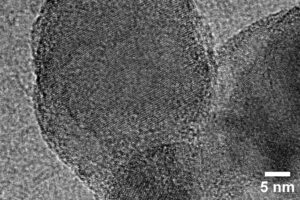
Using transmission electron microscopy (TEM), the research team at CEA characterised both the morphology and particle size distribution of the synthesised nanoparticles, allowing the production process to be refined and optimised.
The resulting nanoparticles exhibit the controlled size distribution required for integration into advanced battery anodes, demonstrating the effectiveness of laser pyrolysis as a scalable synthesis route for energy-storage materials.
The next step will be to apply the same optimisation strategy to the production of carbon-coated silicon (Si@C) nanoparticles.
Why coat silicon with carbon?
Although silicon offers outstanding lithium storage capacity, its large volume changes during battery operation remain a significant challenge.
Applying a thin carbon coating helps overcome this limitation by improving the electrical conductivity of the particles while providing a protective layer that buffers mechanical stresses generated during repeated charging and discharging.
As a result, Si@C nanoparticles can deliver improved electrochemical performance together with enhanced cycling stability, making them particularly attractive for incorporation into silicon–graphite composite anodes.
Supporting the next generation of lithium-ion batteries
Through its expertise in laser pyrolysis and advanced energy-storage materials, CEA is supporting the GR4FITE3 consortium in the development of high-performance silicon–graphite anodes, contributing to more efficient, longer-lasting lithium-ion batteries for electric vehicle applications.
