
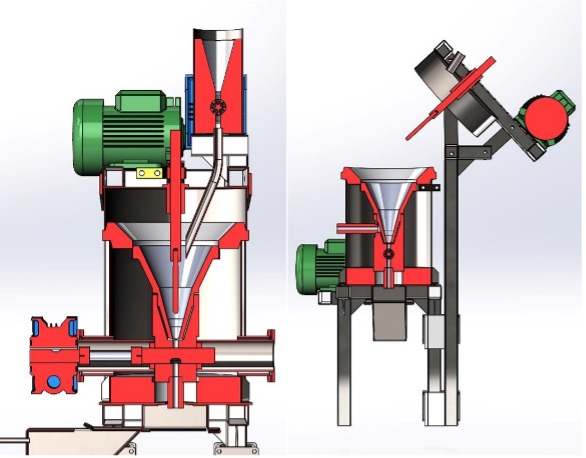
06 July 2026 — Recent research outputs from the project highlight three interconnected areas: surface engineering of graphite via pitch carbonization, industrial-scale thermal processing design, and reactor modeling for high-temperature purification.
Together, these studies point toward a single goal: making graphite anodes faster, more stable, and scalable for industrial battery production.
Pitch-derived carbon coating of graphite: tuning the anode interface
A key performance bottleneck in graphite anodes is the interfacial resistance between graphite particles and electrolyte. Researchers at the Gas Institute of NAS of Ukraine address this by applying a carbon coating derived from petroleum pitch, which is then carbonized to form a thin conductive layer on graphite particles.
In the experiments, spheroidized GAK-2 graphite was coated with varying concentrations of pitch (1%, 3%, 5%, and 10%) and heat-treated in a controlled thermogravimetric system using a very slow heating rate of 1°C/min up to 900°C, followed by a one-hour dwell under a protective argon/nitrogen/hydrogen atmosphere.
During pyrolysis, the pitch decomposes and forms a nanostructured carbon layer on graphite surfaces. This coating modifies both surface chemistry and transport properties:
- It increases lithium-ion diffusion pathways at the interface
- It reduces charge-transfer resistance
- It improves rate capability and cycling stability
However, the study also shows a clear trade-off. BET surface area increases slightly at low coating levels (1–3%), but declines significantly at higher coating content. This suggests that excessive coating blocks porosity and reduces electrical conductivity. The authors therefore propose an optimal pitch content window of roughly 3–8%, where interfacial benefits are maximized without degrading conductivity.
Industrial saggar design: scaling controlled heat treatment to production
While coating works at the particle level, scaling it requires precise thermal engineering at the reactor level. GR4FITE3 addresses this with a mathematical and numerical model for an industrial saggar system designed for graphite powder treatment with a nanoscale pitch layer.
The system is intended for a 30-liter industrial-scale reactor, and the design is based on careful control of heating rates to avoid structural damage to graphite or coating instability. Experimental validation shows that maintaining slow heating profiles ensures uniform carbonization and prevents thermal gradients that could degrade coating quality.
The key engineering insight is that heat transfer is not just a boundary condition problem, it directly controls coating morphology and therefore electrochemical performance.
This model bridges laboratory thermogravimetric experiments and industrial production systems, providing a scalable pathway for battery-grade coated graphite manufacturing.
We talked about this here
Electrothermal fluidized-bed reactor: continuous graphite purification and treatment
The third research direction expands beyond batch processing into continuous high-temperature systems. Researchers developed a conceptual design of an electrothermal fluidized bed (ETFB) reactor for graphite purification and thermal modification.
Unlike conventional fluidized beds used for combustion or drying, this system is designed specifically for carbon materials under high-temperature electrothermal conditions, and has specific key features:
- Tangential gas injection for stable particle suspension
- Conical reactor geometry for improved flow control
- Coupled turbulent flow and heat transfer modeling
- CFD-based optimization of particle–gas interaction
The goal is to achieve continuous processing of graphite while maintaining uniform thermal exposure. This is critical for large-scale battery supply chains, where batch variability can significantly affect electrode consistency.
The study concludes that the ETFB design provides a promising foundation for industrial-scale graphite upgrading and purification, especially for applications requiring tight control of particle surface chemistry and purity.
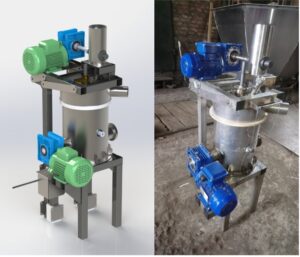
A multi-scale engineering strategy for next-generation graphite anodes
Across all three studies, a consistent engineering philosophy emerges:
- At the particle scale, pitch carbonization optimizes surface conductivity and lithium transport
- At the reactor scale, saggar design ensures controlled, uniform thermal processing
- At the system scale, electrothermal fluidized-bed reactors enable continuous production and purification
Together, these approaches form a vertically integrated process chain for advanced graphite anode manufacturing.
By combining pitch-derived carbon coatings, validated thermal models, and advanced reactor concepts, the project outlines a realistic pathway toward industrial-scale production of high-performance graphite anodes for lithium-ion batteries.
If successfully scaled, these technologies could improve both the rate performance and lifecycle stability of next-generation energy storage systems.
