
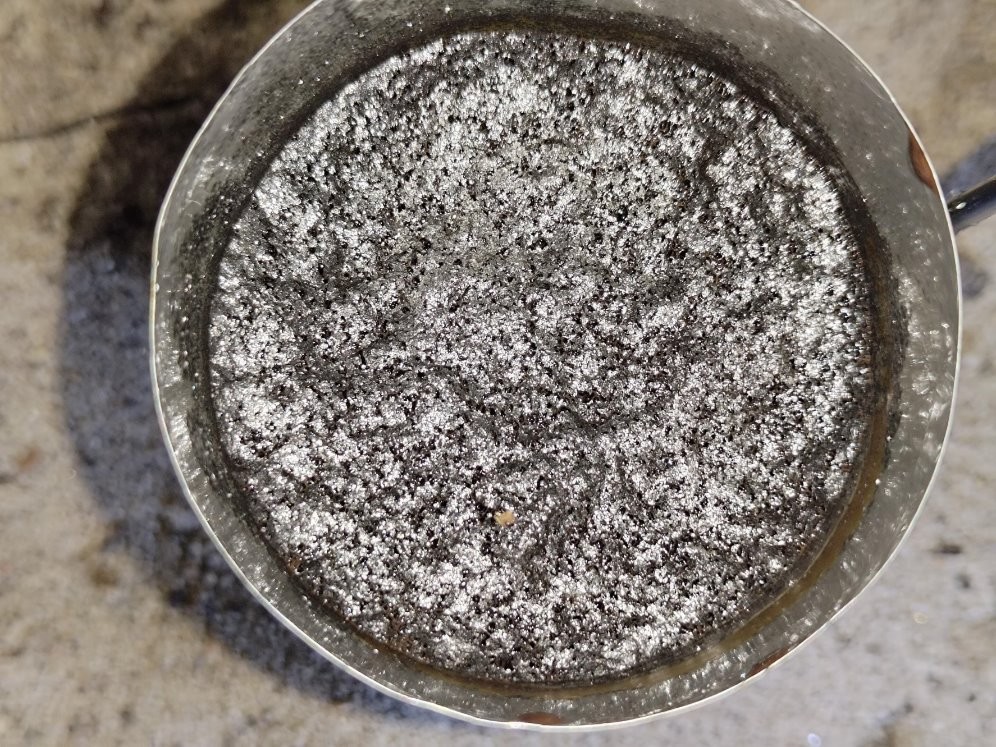
02 April 2025 — The Gas Institute of the National Academy of Sciences of Ukraine continues its pivotal role in the GR4FITE3 project, pioneering advanced graphite purification and processing techniques.
The Gas Institute of the National Academy of Sciences of Ukraine continues to contribute to the GR4FITE3 project, focusing on advanced graphite purification and processing. A key area of research is high-temperature heating techniques for natural flaky graphite, integrating experimental and computational simulations to optimize reactor efficiency and heating rates in protective atmosphere (nitrogen environments).
Using ANSYS Fluent software, the research team designed and analyzed reactor systems for efficient graphite heating. Their simulations model particle heating in an upward coolant flow, enabling insights into vortex formation, particle transport, and key hydrodynamic features. A comparative analysis of classical vs. new reactor technologies—both designed by the authors—demonstrates improved performance in high-speed heating of graphite particles.
A detailed computational model was also developed to track density changes in oxidized graphite particles (from 2080 to 5 kg/m³) during heating, ensuring precise heating rate calculations under specific hydrodynamic conditions. These insights support optimized electrothermal fluidized bed reactor design, a critical component of GR4FITE3’s work on graphite sample processing and carbon coating techniques.
A research devoted to the study of hydrodynamic and thermal properties of graphite powders is directly related to the subject of the Project. The combination of natural experiment and computer simulation allowed to obtain data that can be easily verified in practice, as well as to obtain data previously unavailable for any measurements.
Additionally, the Institute explored modern reactor designs for TEG synthesis, addressing:
- Energy-efficient nanomaterial production for applications in hydrogen, nuclear energy, and gas transportation industries.
- Reactor selection, material flow calculations, and simulation validation to optimize high-performance graphite production.
- High-temperature unit design for lithium-ion battery materials, along with investigations into graphite particle electrical properties.
Future research will refine graphite purification technology, reactor optimization, and material behavior modeling, with a focus on:
- Continuous loading/unloading systems
- Fluidization techniques
- Gas consumption and heating optimization
For more details on these breakthroughs in high-temperature reactor design and carbon nanomaterials, see the abstracts below or contact the team.
The IG Team working on GR4FITE3 can be reached via:
- Alexander Khovavko, Ph.D., Senior Research Associate (ahova2005@ukr.net)
- Eugene Styrativnov Ph.D., Senior Research Associate (Eestrativnov@gmail.com)
- Dr. Angela V. Piatova, International Collaboration Department (a.piatova@kpi.ua)
Related papers:
– CFD-Experiment, Simulation and Analysis of Technologies for Thermally Expanded Graphite Synthesis by Oxidized Graphite Particles High-Speed Heating in Methane Combustion Products Flow
– Carbon Nanostructured Materials – Synthesis, Characterization, and Industrial Applications
—
About the Institute
The Gas Institute of the National Academy of Sciences of Ukraine is a leading research institution specializing in the effective use of natural gas in industry and energy. It plays a crucial role in the development of fuel technologies that address global challenges. The Institute’s research areas include:
• Implementing the European Green Deal objectives in Ukraine,
• Advancing hydrogen use in industry and transport,
• Developing nanotechnologies and nanomaterials,
• Reducing nitrogen oxide emissions to meet European standards.
The Institute follows a structured innovation process, transitioning from fundamental research to applied studies and industrial implementation.
