12 June 2025 — Researchers at Kyiv National University of Technologies and Design (KNUTD) have developed an innovative low-fluoride chemical purification method using a minimal dose of ammonium fluoride (NH₄F) and sulfuric acid.
Natural graphite is increasingly recognized as a strategic raw material vital for Europe’s clean energy transition. Its primary application is in lithium-ion batteries (LIBs), where it serves as the key anode material. Graphite’s ability to reversibly intercalate lithium ions makes it indispensable for battery performance. While synthetic graphite has traditionally dominated LIB markets due to its uniformity and high purity, it is both energy-intensive and expensive to produce. In contrast, natural graphite is more abundant and cost-effective but requires purification to reach the ultra-high purity level of 99.95% needed for battery-grade applications. Developing scalable and environmentally compliant purification technologies for natural graphite is, therefore, a top priority for securing sustainable battery supply chains.
Various purification technologies have been developed for natural graphite, including thermal purification, chemical purification, chlorination roasting, and microwave-based processes. Thermal purification, which exceeds 2500 °C, achieves extremely high purity (up to 99.995%) but is energy-intensive and requires capital-heavy infrastructure. Chlorination roasting and microwave treatment offer promising alternatives but face scalability and equipment challenges. As a result, chemical purification remains the most widely used approach, balancing cost, effectiveness, and operational simplicity. These methods typically use acid and alkaline reagents to dissolve impurities such as silicates and metal oxides. Common reagents include HF, HCl, H₂SO₄, HNO₃, and NaOH, each targeting specific impurities. While these methods can achieve purities between 98–99.99%, the choice of reagents significantly impacts environmental safety and regulatory compliance.
Hydrofluoric acid (HF) remains the most effective and widely used reagent in commercial-scale graphite purification, especially in China. HF-based treatment efficiently removes SiO₂, Al₂O₃, and other oxides through aggressive acid leaching. However, this method presents serious environmental and occupational hazards. HF is highly corrosive, toxic, and difficult to manage safely at scale, generating fluoride-containing wastewater that requires extensive treatment before discharge. Increasing environmental regulations and public health concerns are driving demand for HF-free alternatives that provide similar performance without compromising safety or sustainability.
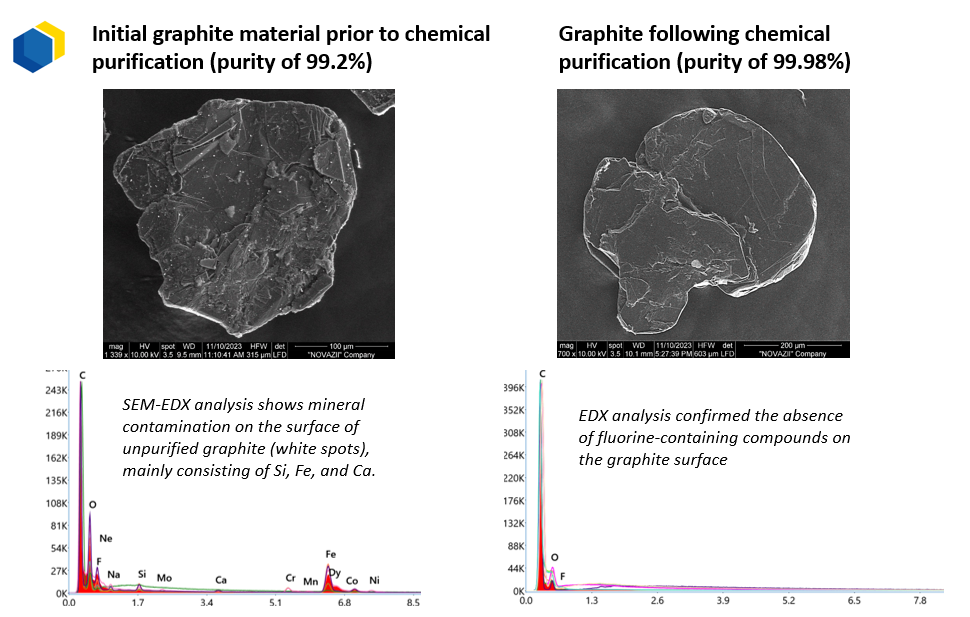
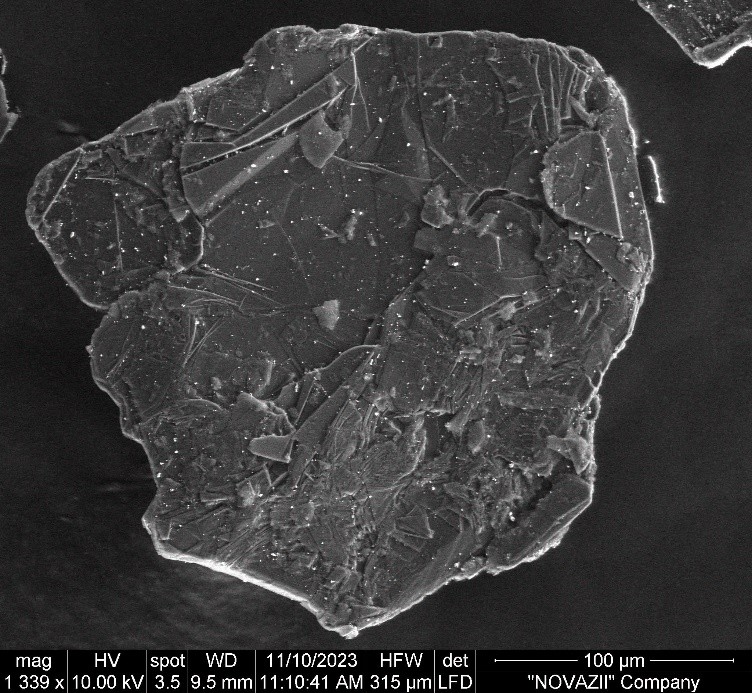
In response to these challenges, the research team at Kyiv National University of Technologies and Design (KNUTD), under the GR4FITE3 project, developed a novel low-fluoride chemical purification method. The technique involves a one-step acid treatment using a minimal, targeted quantity of ammonium fluoride (NH₄F) in combination with sulfuric acid. NH₄F is used not to fully leach impurities but to selectively disrupt crystalline and mineral structures, enabling H₂SO₄ to efficiently dissolve the remaining impurities. This combined mechanism removes Fe₂O₃, Al₂O₃, and silicates while minimizing fluoride use. KNUTD’s experiments confirmed no detectable fluorine on the graphite surface after treatment. The method consistently produced graphite with purities ranging from 99.97–99.99%, significantly reducing reagent consumption and toxicity risks compared to HF-based purification. This innovation supports a transition to safer, greener processing methods and aligns with EU directives on industrial effluents and sustainable critical raw material supply chains.
To assess the potential for industrial scale-up, KNUTD developed a preliminary pilot line design for chemical purification. The conceptual design integrates all process stages into a modular, semi-continuous system optimized for industrial testing and scaling. It reflects both chemical engineering innovation and environmental safeguards, including a closed-loop water recovery system.
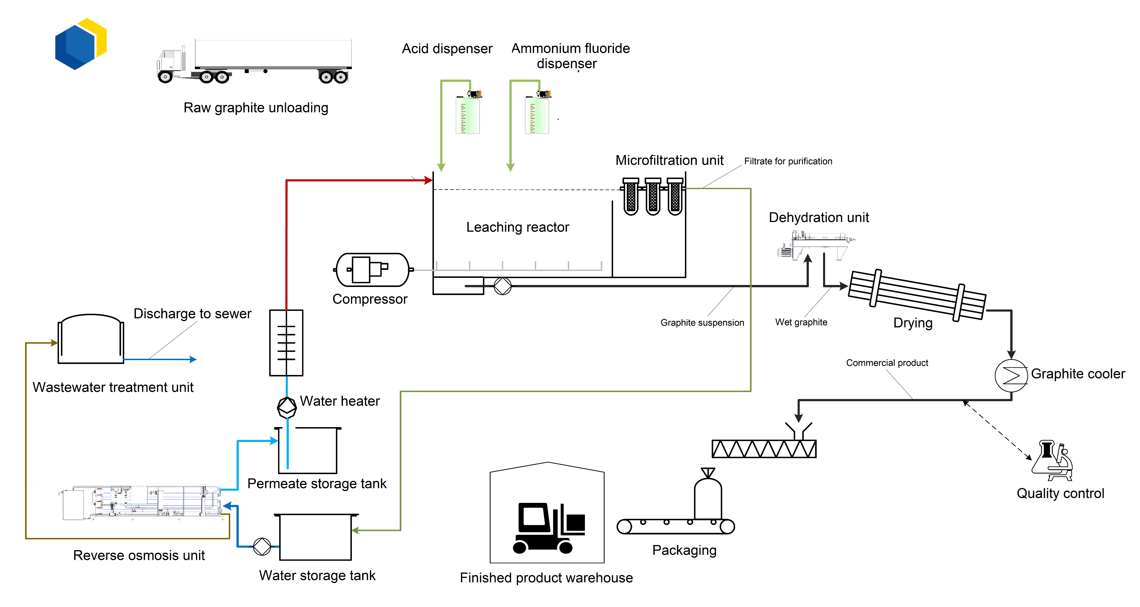
The pilot purification line (illustrated in the image above) includes the following key elements:
- Raw graphite concentrate is delivered and loaded into the system.
- Controlled reagent dosing of H₂SO₄ and NH₄F initiates leaching. NH₄F is dosed precisely to disrupt mineral structures without generating excessive fluorine waste.
- Leaching reactor serves as the core unit where chemical reactions occur. A compressor maintains internal pressure to accelerate reaction kinetics and enhance impurity solubilization.
- Microfiltration unit separates solid graphite from dissolved impurities.
- Dewatering unit removes excess liquid from the graphite filter cake.
- Drying and cooling chamber stabilizes the purified graphite.
- Purity testing verifies final purity and ensures no fluorine remains in the water.
- Storage and packaging prepares the product for shipment.
An integrated water system purifies incoming water, supplies thermally regulated process water, and treats spent water to remove calcium fluoride in a dedicated recovery unit. Treated water is recycled through a storage tank to support a closed-loop system that minimizes environmental discharge.
This design concept allows for localized purification near mining sites or within existing processing facilities. The modular nature supports flexible deployment across various regions and capacities. KNUTD’s approach offers a practical, scalable solution that responds to the demand for decarbonized and chemically responsible battery supply chains.